
Conservit energy guide
BESS Explained: How Battery Energy Storage Works With Solar
A clear overview of battery storage and the questions businesses should ask before investing.
Introduction
Solar power can reduce dependence on grid electricity, but solar generation changes throughout the day. Generation is usually highest during daylight hours, while electricity demand may continue after sunset or during periods of low sunlight.
A Battery Energy Storage System, commonly called BESS, helps solve this timing challenge. It stores electricity when it is available and releases it when it is needed. When integrated with solar, BESS can help businesses improve energy management, support backup requirements, reduce peak-demand exposure and use more of the solar energy generated on-site.
India is also developing a stronger policy and regulatory framework for energy storage. The Ministry of New and Renewable Energy maintains a dedicated section for Energy Storage Systems policies and guidelines, while official planning documents identify growing storage requirements for the electricity system.
What is BESS?
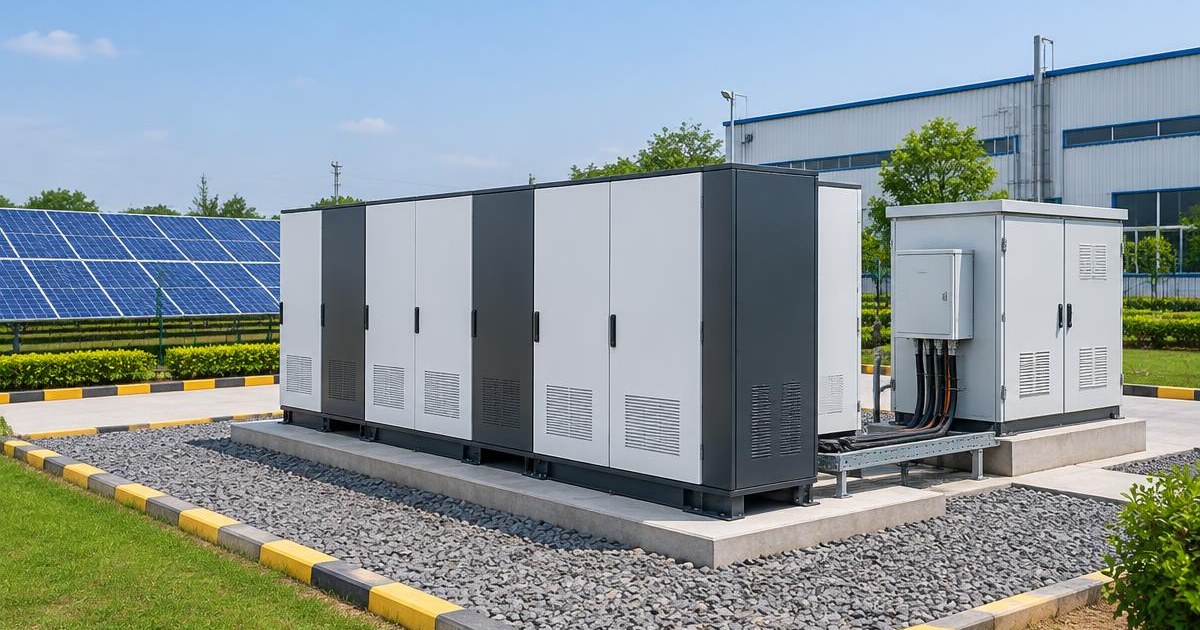
BESS is a system that stores electrical energy in batteries and makes it available later. A complete BESS normally includes:
- Battery cells and battery modules.
- Battery management system.
- Power conversion system or bidirectional inverter.
- Energy management system.
- Thermal management.
- Protection and monitoring equipment.
- Fire detection and safety systems.
- Enclosure, container or dedicated battery room.
- Grid and electrical integration equipment.
The battery stores energy as DC. The power conversion system converts electricity between DC and AC so that the stored energy can interact with solar equipment, loads and the electricity grid.
A BESS is therefore more than a battery pack. It is an engineered electrical, control, safety and monitoring system.
How does BESS work with solar?
A solar-plus-storage system generally follows this sequence:
- Solar panels generate electricity during the day.
- Solar power supplies on-site loads first, where the system is designed for self-consumption.
- Surplus power charges the battery.
- The battery stores the available energy.
- The system discharges stored energy when solar generation falls or the load needs additional power.
- The grid or backup source supports the system when solar and battery capacity are insufficient.
The exact operating strategy depends on the customer’s load profile, tariff structure, backup requirement, system size, battery capacity, grid rules and control settings.
Why do businesses consider BESS?
1. Shifting solar energy to later hours
A business may generate surplus solar electricity during the afternoon but require energy in the evening. BESS can shift some of the available energy to a later period.
2. Supporting backup requirements
When designed accordingly, BESS can provide backup to selected loads during an outage. It is important to distinguish between backing up critical loads and supplying an entire facility.
3. Reducing peak demand
Some commercial and industrial consumers face demand-related charges or high electricity costs during specific periods. BESS may help reduce short-duration peaks, subject to the site’s tariff structure and system design.
4. Improving renewable-energy utilisation
If surplus solar would otherwise be exported, curtailed or used at a lower value, storage can increase the proportion of solar energy consumed on-site.
5. Supporting power quality and resilience
Depending on the equipment and design, energy storage can support selected loads and help manage fluctuations. A detailed engineering study should confirm power-quality benefits rather than assuming them.
Main BESS applications
What should customers evaluate before choosing BESS?
Load profile
Review electricity consumption at short intervals where possible. Monthly units alone may not show peak demand, short-duration spikes or the timing of consumption.
Required duration
Battery capacity is measured in energy, such as kWh or MWh. Power capacity is measured in kW or MW. A 500 kWh battery does not automatically provide 500 kW for one hour unless the system is designed for that output.
Critical loads
Identify which loads require backup. Supporting essential lighting, IT systems or controls may require a very different system from backing up an entire manufacturing facility.
Solar generation profile
Understand when the solar plant generates energy and how much surplus energy is available for charging.
Battery chemistry
Different chemistries have different characteristics related to safety, cost, cycle life, energy density, operating conditions and maintenance. Product selection should be project-specific.
Round-trip efficiency
Energy is lost while charging and discharging. Evaluate the system using usable delivered energy rather than only nominal battery capacity.
Degradation
Battery capacity changes over time and with use. The proposal should explain degradation assumptions, warranty conditions, operating limits and replacement expectations.
Safety and thermal management
BESS projects require suitable protection, ventilation or thermal management, monitoring, emergency procedures and fire-safety planning. India’s official energy-storage work includes ongoing efforts to standardise safety and construction practices.
Warranty and service
Review:
- Battery warranty.
- Throughput or cycle limits.
- Availability guarantee, if applicable.
- Inverter warranty.
- Response time.
- Remote monitoring.
- Preventive maintenance.
- Replacement responsibilities.
- End-of-life handling.
Is BESS suitable for every solar project?
No. BESS is not automatically suitable for every rooftop solar installation.
It may be more relevant when a customer has:
- Important evening or night-time loads.
- Frequent outages.
- Critical equipment requiring backup.
- Surplus solar generation.
- Demand charges or time-based tariffs.
- A requirement for energy resilience.
- A microgrid or hybrid-energy objective.
For a customer whose electricity demand closely matches daytime solar generation and who has no backup requirement, a battery may not provide enough additional value to justify its cost.
A proper evaluation should compare:
- Solar-only system.
- Solar plus BESS.
- Solar plus grid backup.
- Solar plus generator or other backup.
- Different battery sizes and operating strategies.
BESS and India’s energy transition
Energy storage is becoming an important part of power-system planning because it can help manage differences between electricity generation and consumption. The Ministry of New and Renewable Energy states that India’s projected storage requirement includes both pumped storage and BESS, while energy-storage obligations are intended to increase the use of renewable energy in the power system.
At the project level, customers should not rely only on national targets. The business case depends on site-specific factors such as tariff, load timing, outages, battery cost, financing, operating strategy and available space.
How Conservit can support a solar-plus-storage assessment
Conservit can help customers structure the initial evaluation around:
- Electricity bill and load-profile review.
- Solar-generation assessment.
- Critical-load identification.
- Battery capacity and duration scenarios.
- Electrical-integration requirements.
- Protection and safety considerations.
- Monitoring and O&M requirements.
- Commercial comparison of solar-only and solar-plus-storage options.
Conclusion
BESS can make solar energy more flexible by allowing electricity generated at one time to be used later. It may support solar self-consumption, backup, peak management and energy resilience, but its suitability depends on the customer’s load profile and project objectives.
The right question is not simply, “How large a battery should we install?” It is:
What energy problem are we trying to solve, and does BESS provide a financially and technically suitable solution?
Planning solar, battery storage or backup power for your facility? Contact Conservit for an initial project discussion.