
Conservit energy guide
How to Compare Solar EPC Quotations: A Buyer's Practical Checklist
Learn how to compare solar EPC quotations using system capacity, generation, equipment, scope, warranties, O&M, assumptions and commercial terms.
Introduction
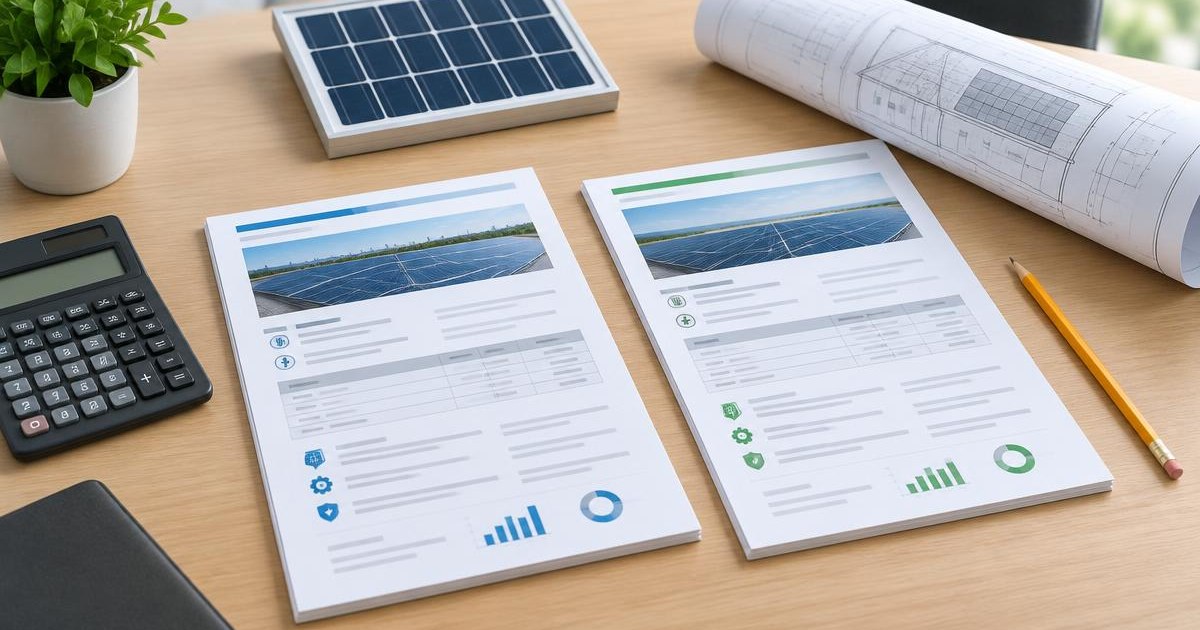
Businesses and homeowners often compare solar quotations by looking at total price or cost per kW. While price matters, it should not be the only decision factor.
Two quotations with the same stated capacity may differ significantly in equipment, design quality, generation assumptions, electrical scope, structural work, warranties, commissioning, monitoring and after-sales support.
A proper quotation comparison should help you understand what you are buying, what is excluded and how the system is expected to perform.
1. Check the system capacity
Confirm whether the quotation refers to:
- DC module capacity.
- AC inverter capacity.
- Export capacity.
- Battery capacity, if applicable.
- Total project capacity.
- Number of modules.
- Number and rating of inverters.
A quotation should clearly state whether its headline capacity is DC, AC or another measurement.
2. Review the design
Ask for:
- Roof layout.
- Module arrangement.
- Inverter location.
- Cable routes.
- Access paths.
- Equipment clearances.
- Shading analysis.
- Structural approach.
- Drainage considerations.
- Maintenance access.
A good layout should balance generation, safety, serviceability and roof protection.
3. Compare equipment details
The proposal should specify:
- Module manufacturer and model.
- Module technology.
- Inverter manufacturer and model.
- Mounting structure.
- Protection equipment.
- Cables and connectors.
- Monitoring system.
- Earthing and lightning protection.
- Metering and grid-interface equipment.
Avoid accepting vague descriptions such as “Tier 1 panels” or “premium inverter” without model numbers and datasheets.
4. Understand generation estimates
Ask:
- How was annual generation calculated?
- What irradiation data was used?
- Was shading considered?
- Were system losses included?
- Was degradation included?
- What availability was assumed?
- What is the expected monthly generation profile?
- Is the number a simulation, estimate or contractual commitment?
Generation varies by location, weather, shading, equipment, cleaning, downtime and system design. A realistic estimate should disclose its assumptions.
5. Check the scope of work
Clarify whether the price includes:
- Site survey.
- Structural work.
- Civil work.
- Electrical work.
- Cable trays.
- Protection systems.
- Transformer or panel upgrades.
- Net-metering or grid coordination.
- Transportation.
- Installation.
- Testing.
- Commissioning.
- Documentation.
- Monitoring.
- O&M.
A low quotation may exclude work that another supplier has included.
6. Review warranties
Separate product warranties from installation warranties.
Ask about:
- Module product warranty.
- Module performance warranty.
- Inverter warranty.
- Structure warranty.
- Workmanship warranty.
- Battery warranty, if applicable.
- Warranty claim process.
- Travel and labour costs.
- Replacement timelines.
- Warranty exclusions.
A warranty has practical value only when the customer understands who will support the claim and how the process works.
7. Compare O&M support
Ask:
- Is O&M included?
- For how long?
- How often are inspections conducted?
- Is cleaning included?
- Is remote monitoring included?
- What is the response time?
- Are spare parts included?
- Are corrective repairs included?
- Will the customer receive performance reports?
- What happens after the initial support period?
The Ministry of New and Renewable Energy’s rooftop-solar O&M guidance emphasizes regular inspection and cleaning practices, reinforcing the importance of defined maintenance processes.
8. Review commercial terms
Check:
- Total project price.
- Taxes.
- Payment milestones.
- Advance requirement.
- Financing charges.
- Price-validity period.
- Exclusions.
- Delay terms.
- Cancellation terms.
- Change-order process.
- O&M renewal price.
- Performance guarantees, if any.
Do not compare quotations until all prices have been normalized to the same scope and tax basis.
9. Compare EPC capability
Ask the EPC provider for:
- Relevant completed projects.
- Similar customer references.
- Project photographs.
- Team and engineering capability.
- Safety process.
- Installation timeline.
- Commissioning documentation.
- Monitoring demonstration.
- Service-response process.
- O&M capability.
A solar plant is a long-term asset. The installer’s post-installation support can matter as much as the initial installation.
Conclusion
The best solar quotation is not necessarily the cheapest one. It is the quotation that clearly explains the design, scope, assumptions, equipment, performance expectations, warranties and long-term support.
Have two or more solar quotations? Contact Conservit for an initial scope and assumptions review.