
Conservit energy guide
Solar Pumps for Farmers: How to Choose the Right System
Learn how farmers can evaluate solar water pumps, including water requirement, pump capacity, solar sizing, installation, maintenance and PM-KUSUM considerations.
Introduction
Diesel and grid electricity can create recurring costs and operational uncertainty for farmers. Solar pumps can help farmers irrigate fields using solar energy, subject to the right pump selection, water requirement and site conditions.
A solar pump is not selected by panel capacity alone. The right system depends on water source, required flow, total head, irrigation schedule, crop type, land layout and available sunlight.
What is a solar pump?
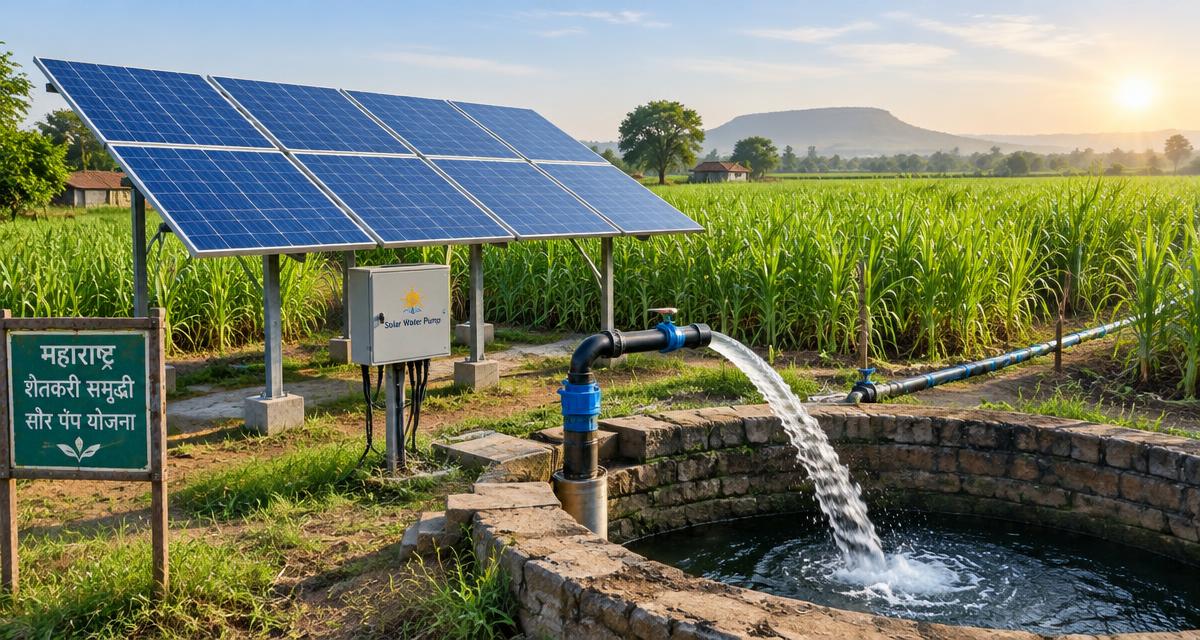
A solar pump uses electricity generated by solar panels to operate a water pump. A typical system may include:
- Solar modules.
- Mounting structure.
- Pump controller or variable-frequency drive, depending on the system.
- Pump and motor.
- Cables and protection equipment.
- Water source or borewell.
- Piping and valves.
- Monitoring or protection devices, where applicable.
The pump may be used for irrigation, drinking-water supply, livestock or other agricultural applications, depending on the project design.
Why farmers consider solar pumps
Reduced diesel dependence
A solar pump can reduce dependence on diesel for irrigation, subject to water requirement, system design and operating conditions.
Lower operating cost
Once installed, solar energy can reduce the recurring fuel or electricity cost associated with pumping, subject to system performance and maintenance.
Support for irrigation timing
Solar pumps can be useful where irrigation is needed during daylight hours and where solar generation is available.
Support for remote locations
Solar pumping can be relevant where grid supply is limited or unreliable, subject to water availability and system design.
Step 1: Understand the water requirement
Before selecting a pump, calculate or estimate:
- Crop type.
- Irrigation area.
- Irrigation method.
- Daily water requirement.
- Watering duration.
- Seasonal water demand.
- Water source.
- Water level.
- Distance and elevation.
A solar pump should be sized for the actual water requirement, not only for the available roof or land area.
Step 2: Understand pump capacity
Two important parameters are:
- Flow rate: How much water the pump can deliver, usually measured in litres per second, litres per minute or cubic metres per hour.
- Total head: The vertical lift plus friction losses in the piping system.
A pump that can deliver high flow at low head may not be suitable for a deep borewell or long pipeline. The pump should match both the required flow and the required head.
Step 3: Assess the water source
The water source affects pump selection and installation design.
| Water source | Key considerations |
|---|---|
| Open well | Water level, pump position, protection and access |
| Borewell | Bore diameter, depth, water yield and pump compatibility |
| River, canal or pond | Water quality, filtration, seasonal availability and protection |
| Storage tank | Tank capacity, elevation, piping and control requirements |
Water availability should be assessed before finalizing the pump and solar system.
Step 4: Select the solar system
The solar array should be sized based on:
- Pump power requirement.
- Daily operating hours.
- Solar irradiation.
- Seasonal variation.
- Water requirement.
- Controller efficiency.
- Cable losses.
- Pump efficiency.
- Maintenance access.
A larger solar array does not always mean a better outcome. The pump, controller, piping and water source must be compatible.
Step 5: Plan installation
A suitable installation should consider:
- Safe and unobstructed solar-panel placement.
- Secure mounting structure.
- Proper cable routing.
- Controller and pump protection.
- Earthing and lightning protection.
- Water-source protection.
- Piping layout.
- Easy access for maintenance.
- Protection from theft or damage.
Step 6: Plan maintenance
A solar pump should be inspected regularly for:
- Panel cleanliness.
- Cable and connector condition.
- Pump performance.
- Controller status.
- Water output.
- Piping leaks.
- Valve condition.
- Structural stability.
- Protection and earthing.
Preventive maintenance can help identify issues before they affect irrigation.
PM-KUSUM and solar pumps
India’s PM-KUSUM scheme supports solarization of the agriculture sector and includes components for standalone solar pumps and solarization of grid-connected agricultural pumps. The official portal states that central financial assistance may be available for eligible standalone solar pumps and solarization of existing grid-connected agricultural pumps, subject to scheme terms and eligibility.[pmkusum.mnre.gov][pmkusum.mnre.gov]
Farmers should verify:
- Current scheme status.
- State-level implementation process.
- Eligibility conditions.
- Approved vendor or implementation requirements.
- Pump specifications.
- Documentation requirements.
- Financial assistance process.
Do not rely on outdated subsidy figures or assume eligibility without checking the current official guidance. The official PM-KUSUM portal provides scheme information and implementation details.[pmkusum.mnre.gov]
Common mistakes
- Selecting a pump based only on horsepower.
- Ignoring total head and friction losses.
- Oversizing or undersizing the solar array.
- Ignoring water-source yield.
- Using unsuitable piping or valves.
- Neglecting cable protection.
- Failing to plan maintenance access.
- Assuming subsidy eligibility without checking current rules.
How Conservit can support
Conservit can help farmers and agricultural businesses evaluate:
- Water requirement.
- Pump and solar-system compatibility.
- Site and installation requirements.
- Electrical and protection needs.
- Maintenance planning.
- Available solar-pump options.